From oct 2010 my educational posts are published only on Pip
Visar inlägg med etikett girls. Visa alla inlägg

6 dec. 2011

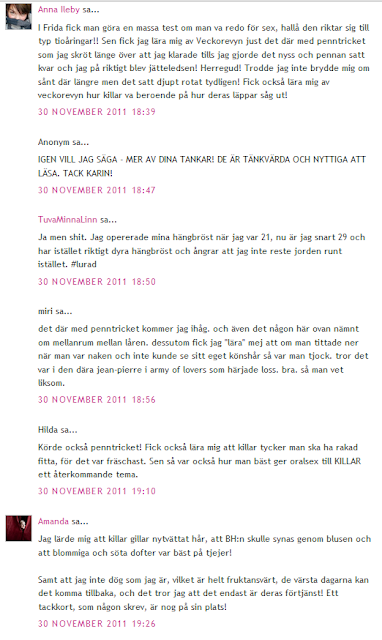
Karins hängbröst veckans bästa läsning

På sex rader har Karin, Karins Konstgrepp, berättat om sin kroppsnoja som hänger i sedan Veckorevyns råd från tonårstiden. Över 100 kvinnor, däribland Veckorevyns chefredaktör, har svarat på hennes avslutande fråga 'Vad har Veckorevyn lärt dig?'. Där redovisas en massa ohyggligt knäppa måttstockar och råd som man som tonårstjej i sin osäkerhet och ovisshet funderade tillräckligt mycket över för att man ska minnas det för livet. Ja förutom chefredaktören då som hävdar att tidningen idag har ett helt annat tilltal.

Det här blev veckans bästa läsning - ett kort minne påfyllt med 100 till av samma sort som beskriver ett äkta och odiskutabelt samhällsproblem och en ouppskattad men väl rotad struktur.


13 apr. 2011

iCarly vs. Shaun the Sheep


Swedish kids younger than 7 years old are devoted to public service children’s TV-channel. There is not really any competition. The public service is the only provider of programs for children from 6 am to 8 pm in Swedish. Other Swedish channels broadcast programs for children an hour at most in the morning and one in the evening. Then there is Nickelodeon and Disney Channel dubbed to Swedish and broadcasting all day, BUT with commercial breaks and other hidden agendas.

Swedish parents choose public service for their kids, produced especially with Swedish children… and Swedish parents in mind. I do, and everyone I know do too. Overall this means programs that are for example gender neutral and diverse and that we think are suitable for kids. There is obviously a gap in the commercial alternatives and what parents want for their kids that public service fills up.

When the kids turn 7 they get the power to choose themselves, and most often they switch channel to Nickelodeon. They think of public service as fun and exciting, while Nickelodeon is considered to be more cool (though also fun and exciting). I’m not sure this tells me very much. Kids say that any program they watch is fun, no matter what the content is.

I tried at home to ask my Nickelodeon watching 7-year old girl to explain why she prefers Nickelodeon. My personal guess is that it presents cool girls and boys (not grown ups, but not kids) and their social relations. It has some sort of romance and what to come mystery about it. I cannot come to think of any specific word that would represent all this to a 7-year old girl and my test object replies – because it’s more fun. It is also self-chosen and completely free from obligations and expectations. Is it fun only maybe?

Then I try ‘What’s the most fun program on the public service channel?’. ‘Shaun the sheep’ she answers and in that battle iCarly is apparently the winner.

My 9-year old has left TV completely since about a year. It’s all the Sims, moviestarplanet.com and Stardoll to her. And to her friends. They are not interacting online yet, but they play it together either several girls by the same computer or via phone. Yet most of the hours she spends alone decorating her virtual suit or creating a movie.

With the immense and immediate popularity of iPad and iPhone amongst very young children the commercial opportunities within the edutainment business is growing fast. Finally we see high quality both fun and educational productions for kids available at very small costs. How much timespent will these alternatives steal from traditional TV for the younger children? How will the needs for and requirements on public service change with that? And the older kids, will they ever return from the computer?

18 dec. 2010

Girls amaze with the right incitaments

When working with Stardoll I got amazed by the users almost every day. They did the most surprising things, maybe not what you expect 11-year old girls to do. When getting the right incitaments million of young girls get extremely high tech and business minded.

In the beginning there were no ways to get Stardollars but through paying real money. Only a few percentages can convince their parents that it is worth it and millions of girls stood stone-broke. This made them very creative. There was a flood of valuable and great suggestions on how they could earn Stardollars. Mini games was a model they knew from other communities, but they also suggested starting own stores, sell their old stuff, get ads on the site, write styling and gossip blogs, become an in game profession or just to get some money every day for logging in. (This was long before any Facebook games). Very few girls asked to get presents as it is part of the game to choose your purchases to create your own identity.

As soon as they got the feature to sell their old stuff and more, they became the world's best promotors and marketers. They used all forums available to announce their sales, to present themselves, to get friends, to make themselves interesting. They try out different messages and learn the effects. They soon learned how to use gift cards to offer eachother real money in purchases instead of Stardollars only as intended.

When starting local campaigns offering special items to different markets, the girls showed advanced tech skills. They easily found out how to track and use a proxy servers and vpn's to take advantage of all offers. Bloggers scan all local version and report where to find what. Through this work they get lots of readers on their own blogs, lots of pageviews and money through ads.

When offering Stardollars in reward for playing mini games, there were soon girls connecting systems/bots for cheating. Overall we learned that if there was a chance that anyone would be able to do something unintended, they would. Sometime they found out an extremely tricky pattern of logging in and out and clicking different buttons to get blue hair and so on.

This is only positive! They are devoted and engaged and it's extremely important to see how the right incitament can get any girl interested in technique and business. It only tells me that education in schools have not yet understood this.

29 juli 2010

Everybody wants happy users

When searching on ’responsibility cyber bullying’ almost all hits concern the schools’ responsibility in this. E-mail, sms and personal homepages have eased being bad to each other. Teachers, parents and school have a tough time raising kids to humanitarian citizens.

When working with Stardoll, we’ve seen this as a part of the responsibility to run a community, as well as a demand from the users. We early decided we wanted our members to leave the site ever day in a comfortable and even empowered mood. A bullied girl is not feeling empowered.

When inheriting 200 dolls and 200 000 member pages from Liisa, I spent many months parallel developing the game and hours in customer service. It stood clear from day one that there was a subculture of girls who liked girls who was not combinable with most teens and tweens from all over the world. Only their names made me blush and both their language and missionary were not appreciated by most other users. We erased these kind of accounts again and again and again until they accepted that this was no longer a place that they could use for their purpose (might sound harsh, I hope they have their community somewhere else where everyone feel comfortable and are happy with this, maybe even get empowered by it).

Next question was not as evident. We could clearly see from the user input that American tweens were much more sensitive to foul language than most others. With their background they did not let one little ‘shit’ pass and they reported everything. By our Swedish standard I guess we found these kids a little policiere and prudent. When translating the site to several languages we implemented a strict language filter that doesn’t let any bad words through. When releasing this feature we had to take a stand – what words did Stardoll accept and not? Would older and European users find the conversation too childish and boring if they weren’t able to write even the tiniest little ‘shit’? We considered that if half of our users didn’t feel comfortable with this language, we had to try to ‘raise’ the rest to accept this. We never had ANY comment or disapproval of the strict language filter.

One of the conceptual values we worked by when developing the site thereafter was ‘Safety’ (later Haven). The girls should be safe to be on Stardoll. Safe to be girls. Safe to try out their style, personality, social interaction, creativity and more. Safe to be online in a big community.

The members also kind of raise each other, they let others know what is ok and not, but to get there the community have to set the right premises. In every decision – in everything from sales, design, banner production, conversion layers and in all communications with the members - we weight in the value concept of Safety. Doing this the entirety will come as close the the ideal goal as possible. Example of details where the Safety value makes big difference is

- Categories available for report. Presenting specific categories for the users to report each other in gives a hint of what is accepted and not.

- No personal information is aloud. Both language filters and categories for report informs of this. All reports are followed up.

- Only winners are presented, other voting results are not visible for anyone. It’s not empowering to get bad votes on something you have put lots of effort on, and it’s an obvious trigger for others to pick on you. The trigger ‘to win – to become covergirl’ is the only that matters, internal hierarchies are not necessary for a great game.

- The copy in a banner is changed from - ‘Everyone is pretty on Stardoll’ to ‘Be who you want on Stardoll’.

- No real life images of members are allowed as they would completely destroy the possibility to try out different personalities without being bullied. The game would be ruined.

- There are space for 30 Best Friends in the presentation, not only one. If only filling in one, the empty spaces look kind of... empty.

- Despite user requests we don't publish a bold Britney Spears when there is something that doesn't seem sound.

- Keep at least one gift free for everyone to give to anyone and encourage to send this gift to newbies and others. This gift must thereby be very general and maybe even be a trigger to start a conversation.

At rare occations when this value has been compromised, when prioritizing something else before the Safety, there has appeared leaks where cyber bullying has found its way. If there is only a tiny chance that a feature might lead to attempts to cyber bullying, it will. It’s a choice – a safer, maybe little less challenging/fun/selling version of the feature to avoid an overall negative experience.

This kind of ‘leaks’ must then be followed up and contraproduced. We run a Best Friends Forever campaign. In the first step we encouraged the members to suggest how to be a good friend on Stardoll. We put 10 of the great suggestions together to a code of conduct and for ten days 200 000 girls returned every day to sign under each of the bullits. The campaign was hugely appreciated and the bad tone we had experienced was calmed – for some time…

I guess what I’m saying is - parents, teachers and users – tell the people behind the features what you want! Don’t work against cyber bullying on your own, but take the producers to your help. They have great opportunities to make impact, to reach out.

24 juli 2010

Girls’ Games IV – tweens and teens today are same same but different


We adored Madonna, today there is Lady Gaga. The through all times eternal icon for all girls of any kind is Marilyn Monroe – these are the women who are sexy and thereby adored by men, but who still keep the power over themselves and turn the worship to their own profit. This is why big busted Lara Croft worked well also for women even if her breast size was debated.

We found inspiration in future heroes Princess Leia, Ripley and E.T. Today’s girls get inspired by mystic Bella Swan, Arven and Avatar. I’d say the only difference is that in the 80s space was the mystery – the future, today the Twilight zone is what we long for – a place we don’t know anything about and therefore can have promising hopes for.


TV provided us with Pamela Barnes Ewing, Sammy Jo Carrington and Melissa Channing. Today it’s Hannah Montana, Lauren Conrad and Sara Sidle(CSI) and many more. In the 80s the grown up intrigues were showing us how normal we were in our real lives. Today someone else’s strange real lives are telling us how boring we are in our real lives.
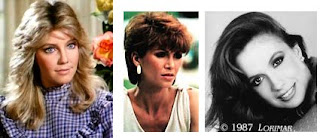

We wore Levi’s, Converse and biker tights. Today’s girls dream of Chanel, Miss Sixty and Louis Vuitton. The economy is kind of different and the kindness of the parents has grown.


We screamed after Michael Jackson, Kiss and a little later on Public Enemy. Girls today have a wider selection and much younger, almost peers to follow. Some of the faves are Tokio Hotel, Robert Pattinsson, Zac Efron, Jonas Brothers, McFly.


So the habits are the same while there are minor differences in economy, lifestyle and male icons. What differs is of course the standard access to Internet, mobiles and games.

Most remarkable is probably the mobile phone use. 54% of all am teens text daily and sends and receives 50 or more messages per day – 1500 per month! 14-17 year old girls are the most active texters, sending 100 or more messages per day.

Next is that girls play games.
97% of all American kids and more than half of American adults play often. The NPD Group report “Gamer Segmentation 2009,” says that 28% of females are playing video games (40% of all players). But not all female gamers are young. More than 33% of women ages 18 and up play video games – surpassing the 18% of boys ages 17 and younger who play video games.

With Stardoll’s 60 million members there is no doubt that girls like and spend time on online fashion games, if they are designed the right way. A majority of the girls on Stardoll are 11-12 years old.

Stardoll was specifically designed for these young girls – those who had left their Barbies and who started to turn to the grown up world for the first time. It was designed to be a free pass from school yards’ peer pressure and from impossible media dreams. It’s a place where girls know they are welcome, where they are safe to be girls. It’s a place where they can explore their growing personalities and try out both looks and social behavior without worries, restrictions or risk taking. They can’t do anything wrong, their creations are always right, they are right.

But it is also those who still have the time
, and who is still more in an experimental world of play. Around the age of 15 these girls are turning to the real world for real life practice. They almost don’t play computer games at all.
What they practice on and offline is self marketing – to be seen. They blog and participate in social networks to promote themselves. They do absolutely use Facebook or other social networks, but not as often as those age 25-45 years old. They don’t need to, they see their friends much more often than we oldies do.

Overall the media time spent is not that different!
8-18 years old spend 32% of their media time on TV, 25% on their computer and 20% on their mobile phone. Consoles only take 5% of their time, partly due to that it’s not a multimediatasking activity. Both TV and videogames are decreasing the older the teenager get, while music takes more and more of their time. Style, music and friends make the identity.


Going back to my own teenage head I guess girls run about the same kind of mental life today. Friends and media are the only things that matters. Popularity and being seen is in focus and most girls don’t have time for games between school, sports and friends as soon as they are free to go and do where/whatever they want.

all stats are found here

Previous Girls' Games Posts
1980-1984
Kids 2010
1984-1994

17 juli 2010

Girls' Games I - 1980-1984

I'm thinking about girls' games, why and what they are, and I begin here today with my own experiences of games, friends and what we played back then around 1980-1984.

Me and a friend went to see a movie on our own for the first time when we were about seven. We choose Star Wars. Soon after dad returned from the States with a Star Wars printed long sleeved t-shirt for me. I wore it every day. It made me kind of interesting and in and Princess Leia in the front of the image was radiant.

Star Wars was a big thing by then. The boys in class did nothing but played with Star Wars dolls (for boys called figures, for girls dolls), while the girls had absolutely no interest in spacecrafts’ heavy artillery down the sandbox, resulting in explosions throwing the dolls, sorry figures, in all directions. We were lining up for ‘throwing ball at the wall’, where the rules were clear and everybody waited for their turn. Conflicts were by that easy to solve through discussions, and no pell-mell necessary. A few of the guys were sometimes jumping in.


About the same time most of us got a Game & Watch. I got some strange copy from dad when he came home from Asia. There was also a digital watch including a plane bombing game that gained me some status amongst my classmates.

Neither Star Wars or these first games had any gender tags by then. They were marketed as family entertainment.


A couple of years later the talented boys (these later on, not very cool guys) in class started to focus on Dungeons and Dragons, as well as designing road and water maps on checked paper. The girls at that time were lining up for jumping twist with rubber strings, waiting for our turn, following the rules. Sometimes we tried to adopt the guys’ interests as football and marbles just to get some time spent together, but most of all we enjoyed the mixed teams hunting each other down on the meandering backyards. Actually when thinking about it, the same guys sometimes jumped in on the rubber strings and also preferred the mixed team hunts.

A guy in our class got an Atari console. We used to gather at his place to race with cars. The girls tried it. The guys had absolutely no problem with that, and they did not in any way try to exclude us, and yet we weren’t that interested, only for shorter pauses in more interesting real life interactions. Soon all boys had a console at home. None of the girls did. I guess also the parents found car racings and war games more proper for young boys than for the girls.

As I remember it the girls and the boys had different interests of their own as well as mixing up and trying out each others' games. The theme of the console games did by time not match the girls' interests at all why the games became a boys' thing.

To be continued...

14 juni 2010

Female Role Models needed


I need women showing me their achievements. They inspire me. They show me how much courage, effort and patience I need. They tell me what I can expect so that I don't get disappointed but is armoured and prepared for the struggle I need to put up, but also that it is worth it.

The current image of who is born to do what is slowly changing in all different part of the world and women and ethnic minorities are gaining more and more equal value to the white and to the man. Many people don't know this - how big the small difference still are, but they effect me and my life every day.

Women have put their marks in the history writing, and sometimes they should have, but someone else was rewarded in their place, or they were ignored as unimportant in a male context.

Please, let me know any woman you feel has her rightful place in history, or any woman you think is missing!

You are never alone
How did Lady Lovelace talk?
Be the Cook for the Best Product
Barbie is fake, Pink is not
Alice ännu mer i underlandet
A good start of 100 most important women through times, by Shelby Ellery

13 juni 2010

Alice ännu mer i Underlandet


Var just och såg Alice i Underlandet med några små söta tjejer som sällskap. Visst var det en vacker film med figurer och scener man inte vill sluta titta på, men karaktärerna är ganska själslösa och försöket att ge den gamla helgalna sagan någon sorts förklaring och vett är faktiskt lite tråkig. Det som alltid har varit så galet med Alice i Underlandet, allt man inte fattar och som förblir utan förklaring, blir inte så kul när det anas lite förstånd någonstans.

Hattmakaren och den Röda drottningen är så klart estetiskt intressanta att se på, men det är bara Alice själv som ger filmen någonting av eget värde i form av historieberättande. Sällan har en så tunn och blek flicka så trovärdigt förvandlats till bästa drakdräparmaterialet - en ståtlig kvinnlig riddare i rustning som tidigare bara setts i Jean d'Arcs skepnad.


För mig som vuxen blev istället Tim Burtons nydanande feministiska affärskvinna Alice för långt från verkligheten för att kännas trovärdig (hur ofta på 1800-talet tror ni en just nekad svärfar erbjuder en flicka tjänst i handelsföretaget), men små tjejer som ännu är helt ovetande om denna verklighet får äntligen en varierad bild av vad som kan hända en söt tjej som ramlar ner i ett hål i marken. Välbehövt!

Recensioner av filmen på Rotten Tomatoes är hälften positiva, hälften negativa. Filmen är en egentligen en renodlad barnfilm, helt utan spänning, känslor eller komplexitet och har hittills dragit in 319M $. Hoppas det är riktigt många unga tjejer och killar som har fått vidga sin bild av vem som räddar riket och hur man lever lycklig i alla sina dagar.

26 mars 2010

You are never alone

I got a little perplex yesterday, reading a striking post on our role model Lady Lovelace. Although it is my mantra and foundation in all I do, it’s still the strangest feeling everytime you realize how true it is that you are never alone. I’m stuffed with studies on why girls often/normally don’t take interest in techniques, and yet this post again put the finger on my own personal history up til today.

The author Audrey Watters describes how she in the late seventies got her first inspiration from Princess Leia, was more into geek things but yet ended up as the girl ‘who minored in Women’s Studies but took the “easy” science and math classes for graduation because somewhere along the way I’d got the message that science and technology weren’t really my thing.’

I did all that. My second daughter is not named Leia for no reason. The impression of the original has never vanished. I’ve always been all brains in school although my friends never expected it and got just as surprised by the exams every year. I hid it well, and did my best not to stand out as a swot. I wanted to be the cool, soft type hanging outside the school gates (even though I didn’t smoke, smoking was too stupid for me) and did well on that role. Also I wanted to become a photo model, it was the times of Paulina Poriskova, Claudia Schiffer and Emma Wiklund – or winning the Nobel Prize – kind of split idea of who I was, typical to most young girls today I guess…

Of course I followed friends and other normal people for the standard studies of economy. Tech school never even came close to my mind. The image of me amongst hundreds of geek guys was just not realistic (today geek has quite a better status even amongst girls then it had before the Internet era). Yet the interest for computers and programming was persistent and after years of studies in the more female populated classes of communication, media, pedagogy and hr, I ended up in the right spot of the by the time so called ‘Multimedia’. Creative presentations on CD-ROM lead me further to social medias as MUD’s and MOO’s, lead me further to programming chat bots.

Probably due to my split goals and feeling of not going in the fully right direction being steered by powers above my own head, I early developed the deepest interest for genus studies and realized how much work there is still to do on the boys vs girls thing in all fields. The origin for me working with MOO’s was a friend and partner who considered himself not to be neither a girl or a boy, but a sex not defined, but in the virtual existence he could be what is felt he was. When programming chat bots the genus aspect arised again in the dialogue between a real life person and a fictive man or woman.

When I finally got the offer to inherit 200 dress up dolls (a genius idea by the founder Liisa) and expand them to a complete ‘game’ for young girls, there was no risk. There were no such great places for girls at the Internet 5 years ago. There was an empty hole to just fill. When offering young girls what they are interested in within the computer we are one step closer to allowing them to further develop the possibilities. Today girls know that they are on the right spot, doing the right thing when they sit by the computer. It’s a small but good start.